



Liberal Studies
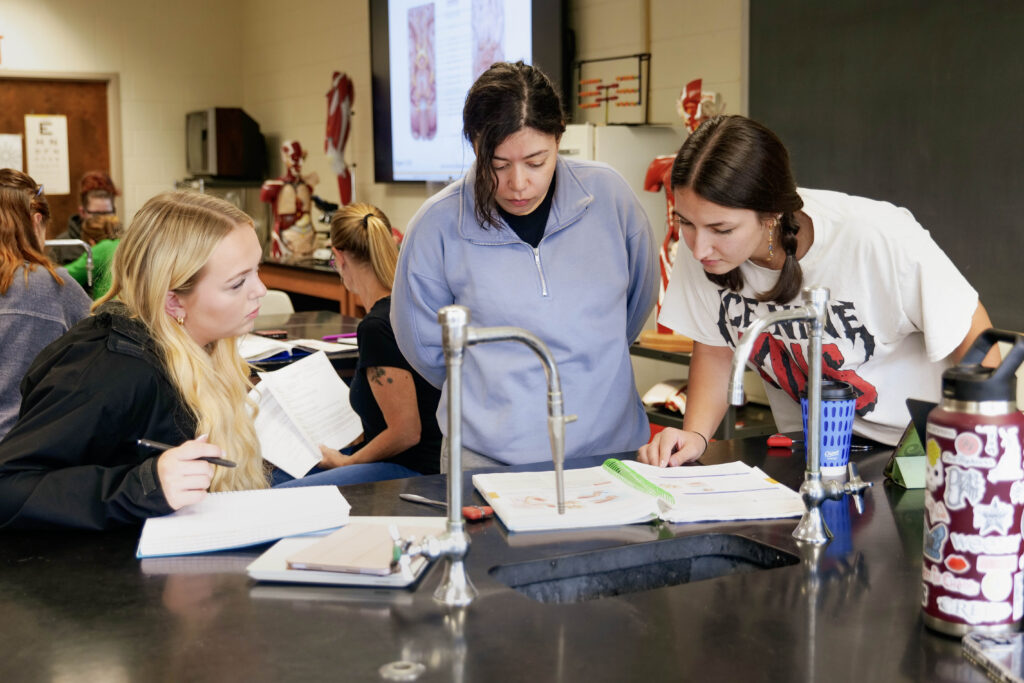


The Associate in Arts in Liberal Studies is a broad, transfer-focused degree spanning writing, literature, philosophy, the social sciences, mathematics, natural science, and the creative arts. It is designed for students who plan to continue on to a bachelor’s degree, and for students who want a strong general education foundation before committing to a specific major.
Between 24 and 27 credits are free or directed electives, so you can explore a discipline in depth, whether that is psychology, history, business, or science, while completing the general education requirements nearly every four-year program expects.
- 61 to 64 credits for the Associate in Arts degree
- Four semesters of full-time study, with part-time options available
- Fully online, on campus in Bangor, or a mix of both
- Block transfer agreement with the University of Maine System
Transferring to a Four-Year School
The block transfer agreement with the University of Maine System means the completed degree transfers as a finished general education block rather than being evaluated one course at a time. EMCC also holds articulation agreements with other regional colleges and universities.
Of the credits you earn, 34 to 35 make up the UMS transfer block, distributed across eight requirement areas:
| Requirement Area | Credits |
|---|---|
| Writing | 6 |
| Quantitative Literacy | 3 to 4 |
| Natural Science | 4 |
| Creative Arts | 3 |
| Social Sciences | 6 |
| Humanities | 6 |
| Diversity | 3 |
| Ethical Reasoning | 3 |
| Transfer block total | 34 to 35 |
Start the conversation early. The school and major you are aiming for should shape which electives you choose along the way, and the receiving school always makes the final decision about credit. An advisor can help you build a plan that lines up with where you want to end up.
- Transfer Agreements
- Transferring from EMCC
- Questions about transfer planning: emccadvising@mainecc.edu
Program Learning Outcomes
Students who complete the Associate in Arts in Liberal Studies will be able to:
- Writing. Write clear, coherent texts with adherence to proper mechanics, and use writing to engage in and communicate processes of critical inquiry, including analysis, synthesis, and argumentation.
- Quantitative Literacy. Reliably perform mathematical operations at the college level, and apply mathematical concepts and techniques in practical situations to solve problems.
- Natural Science. Engage in laboratory or field work at a level consistent with standard college laboratory and field courses, and work with both qualitative and quantitative information in applying the scientific method.
- Creative Arts. Participate in, identify, or evaluate artistic and creative forms of expression.
- Social Sciences. Analyze or explain causal forces which shape social structures, institutions, or behavior.
- Humanities. Analyze or interpret significant texts or other cultural artifacts, and think critically about meaning and value from an aesthetic, philosophical, or multidisciplinary perspective.
- Diversity and Cultural Knowledge. Demonstrate knowledge of cultural differences.
- Ethical Reasoning. Explain the premises of ethical decision making and apply a framework for making rational choices when faced with ethical dilemmas.
Admission Requirements
A high school diploma or a state high school equivalency certificate (GED or HiSET), plus a completed application.
EMCC places students into math and English courses using transcripts, GPA, and standardized test results. We may ask you to take the Next Generation Accuplacer exam if those sources do not provide enough information.